Exegesis and Theology

The Blog of Brian Collins

  • About
  • Writings
  • Recommended Resources
  • Categories
    • Christian Living
    • Book Recs
    • Biblical Theology
    • Dogmatics
      • Bibliology
      • Christology
      • Ecclesiology
    • Church History
    • Biblical Studies

Kaiser on Rest and Bauckham on the Lord’s Day

December 11, 2018 by Brian

Kaiser, Walter C., Jr., “The Promise Theme and the Theology of Rest,” Bibliotheca Sacra 130 (1973): 135-150.

This is a helpful survey of the rest theme in Scripture. Kaiser’s own summary:

The rest of God is distinctively His own rest which He offers to share first with Israel and through them with all the sons of men who will also enter into it by faith. While there were antecedent aspects of that final rest to come, chiefly in the divine rest provided by the inheritance of the land of Canaan; because it was not accompanied by the inward response of faith to the whole promise of God, of which this rest was just a part, the land of Canaan still awaits Israel and the people of God. The rest of God, lost in the fall, again rejected by the older wilderness generation and subsequently by their erring children is still future to us in our day.

The dead will enter into its full enjoyment after their resurrection from the dead (Ps. 116:7), therefore it is not to be identified with heaven. Rather it is fixed by Isaiah 11:10 as being “in that day” when “the Lord will extend his hand a second time to recover the remnant of his people” (Isa. 11:11). In that eschatological setting, “his rest” (not “dwellings” as in RSV) shall be glorious. Then the Lord shall choose Jerusalem as His dwelling place, and this new David will say, “This is my resting place for ever” (Ps. 132:14).” [149-50]

Bauckham, R. J. “The Lord’s Day.” In From Sabbath to Lord’s Day: A Biblical, Historical, and Theological Investigation. Edited by D. A. Carson. Eugene, OR: Wipf & Stock, 1999.

This is an excellent examination of Revelation 1:10 in its historical and canonical context. Bauckham makes the case that the Lord’s day in Revelation 1:10 is Sunday. He further argues that the day was significant to the message of the book, which centers on the issue of sovereignty. The person you worship is your lord. Here it is fitting for the revelation given to John about the reality of Christ’s lordship and his coming full triumph to be given on the day the church gathers to worship. This connection between Christ’s sovereignty and the Lord’s day is strengthened by its being the day of Christ’s resurrection, which marked his triumph over opposition to his sovereignty. The Lord’s day, then, is to be a day of worship in anticipation of our Lord’s return and the full and visible manifestation of his sovereignty.

Filed Under: Biblical Studies, Biblical Theology

J. I. Packer, Knowing God

December 1, 2018 by Brian

Packer, J. I. Knowing God. IVP, 1973.

There is good reason that this book is considered a classic. It is an accessible introduction to the essentials of the Christian faith. A Christian with few books who mastered this one alongside his Bible would truly be a theologian in the older sense of theology: the science of living blessedly forever.

Filed Under: Uncategorized

Logos 8 Review

November 21, 2018 by Brian

Logos 8 arrived earlier this month, and FaithLife (Logos’s parent company) was kind enough to send me a review copy. I’ve been using it for the past several weeks now, and what follows are a few of my favorite features along with some constructive criticism.

Canvas

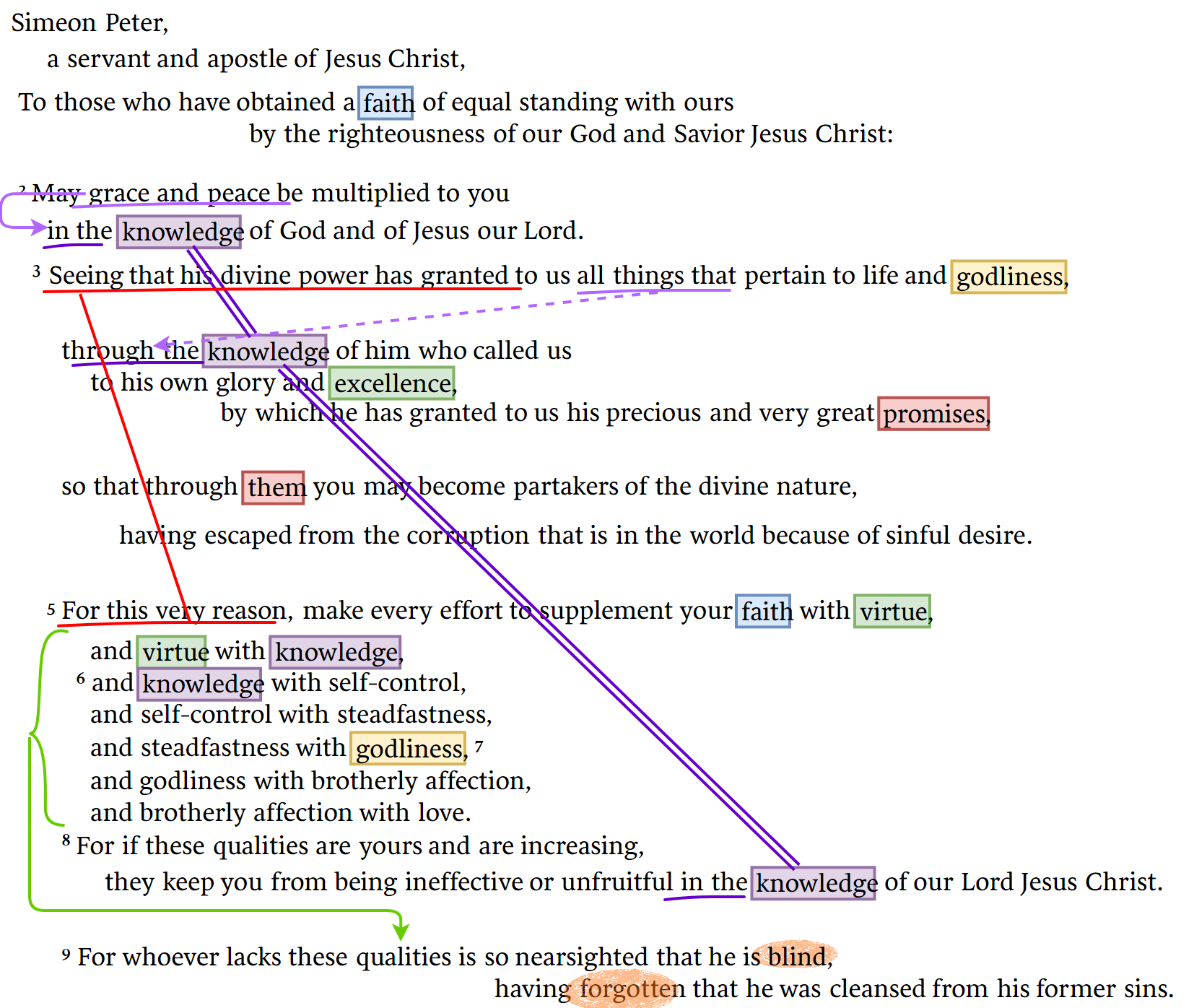
Something that I’ve long wished was part of Logos’s highlighting toolbox is the ability to draw lines between key words in a text. I frankly thought that feature would never come due to technical challenges, but the canvas tool makes it possible to do that and much more. Below is an example I produced fairly quickly using Canvas.

Logos’s own blog post about Canvas shows it being used for more creative, artistic purposes, but expect I’ll use it most often to structure and highlight a passage. Because of this, one feature I hope Logos adds in the future is the ability to use the custom highlighting palates that can be used in other resources within Canvas.

See this page for a video and some other Canvas examples.

Workflows

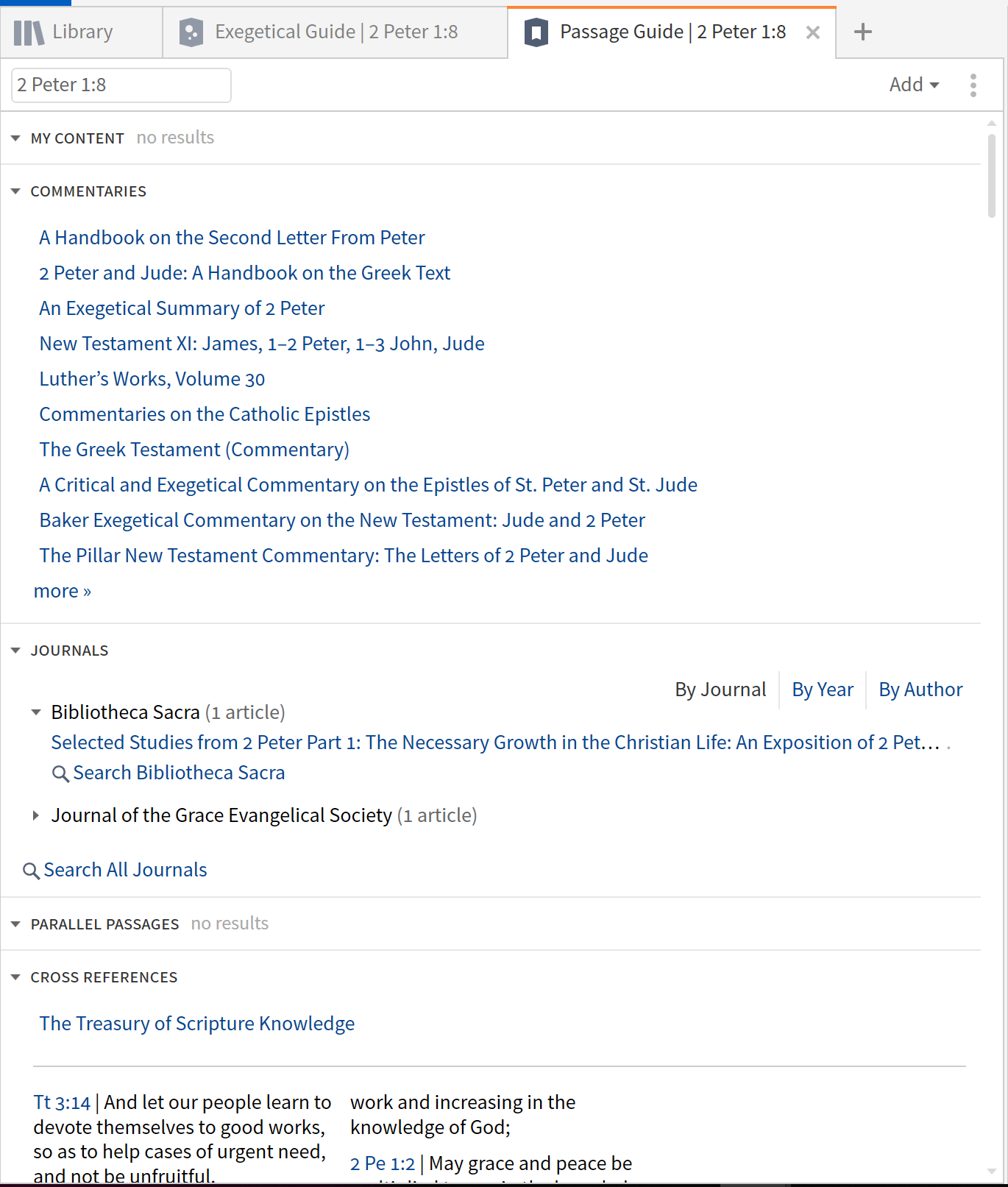
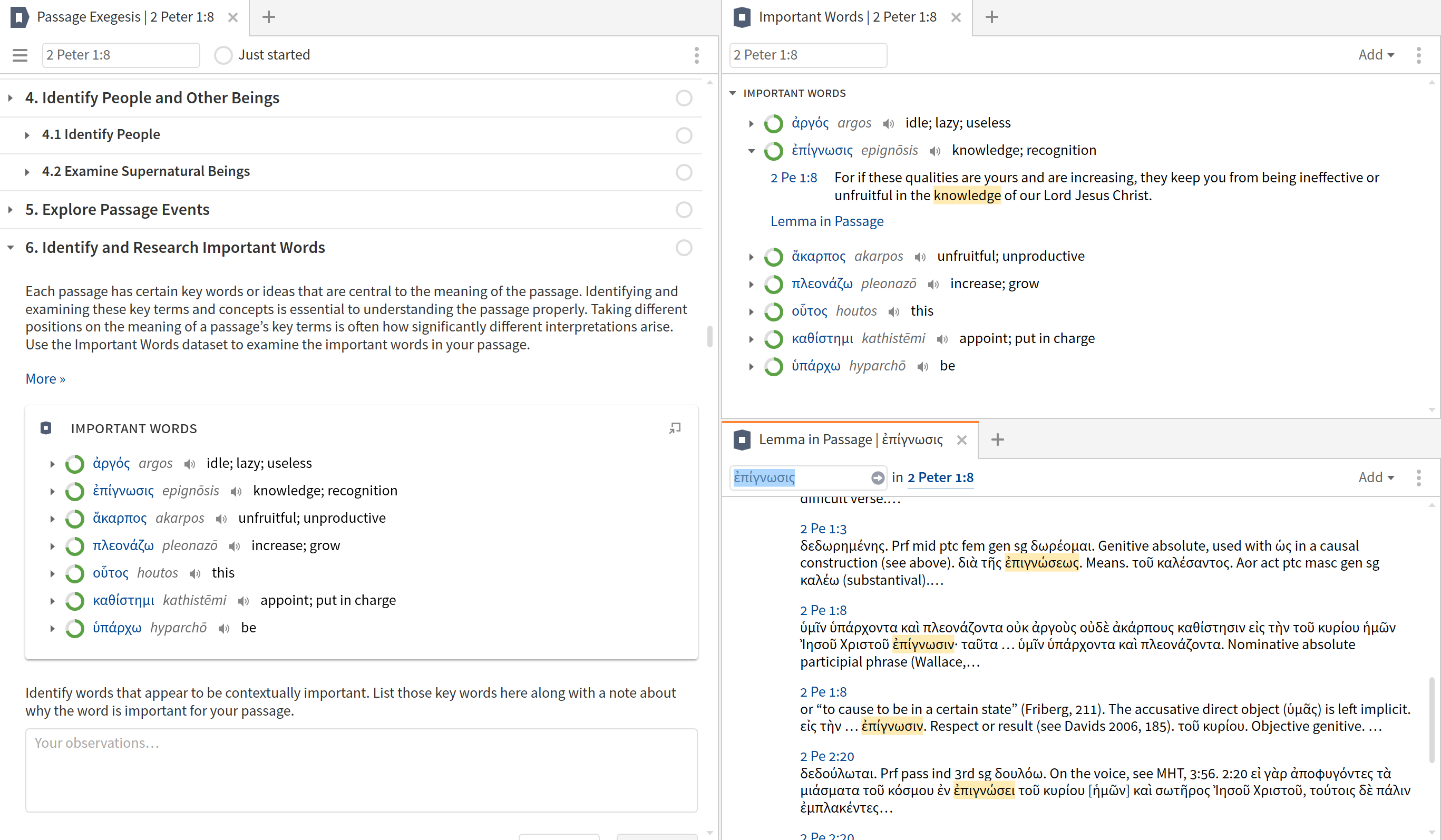
One of the challenges with Logos is sifting through a large library of resources to find those most relevant for one’s present study. One way Logos has addressed this problem in the past has been through passage guides or exegetical guides.

Here are some examples from the passage guide:


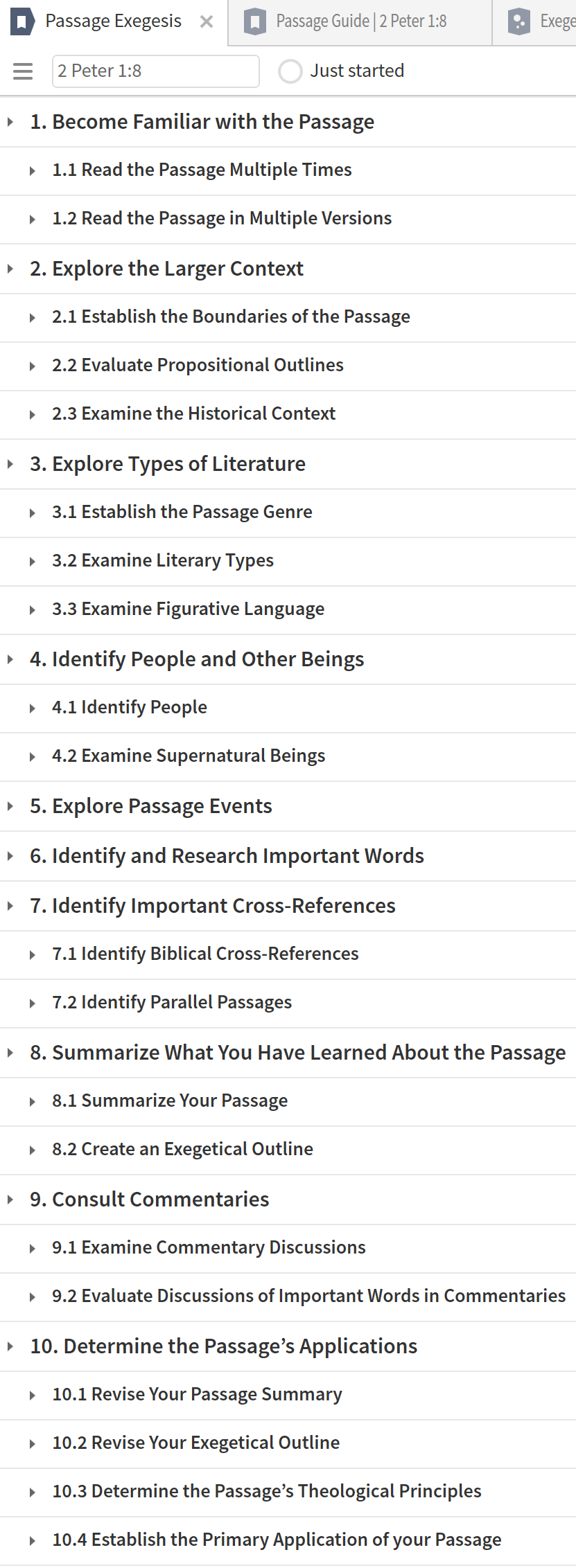
Workflows take this concept to the next level and provide a click-through guide for how to study a passage. Here is the list of steps for the Passage Exegesis Workflow:

Within these steps, the workflow will direct users out to various resources:

Workflows are customizable, so if there are steps that you can do without or do without being prompted by the workflow, you can customize the process.

In addition to workflows that are focused on studying Scripture, Logos also included a workflow for praying Scripture. On the one hand, the process is simple enough that a workflow isn’t really needed, but part of the utility of the workflows is to teach people how to do something. I can also see using this workflow as a way to discipline myself to slow down and be more intentional in praying through Scripture.

For a video about workflows, see here.

Lexham Survey of Theology / Theology Guide

Another new feature of Logos 8, and one to which I contributed, is the Lexham Survey of Theology. Information from this resource is also presented and expanded on in the theology guide.

The LST provides a brief definition of a theological topic followed by an entry which summarizes the topic. Key passages and recommended resources follow the entry. In general, I think the summaries are helpful, though there are some which, unfortunately, seem to argue for a viewpoint instead of surveying positions. I contributed entries relating to the themes of covenant and law and sought to provide a summary of viewpoints followed by suggested resources that represent the range of viewpoints on the topic.

I think the resource recommendations and the key passages may end up being the most useful part of this resource.

For a video about the theology guide, see here.

Touch and Pen

I use Logos on a Surface device, and, in general, it works well with touch. I’ve used the Logos mobile app on both iOS and Android, and while the mobile app is nice, I prefer the full-featured experience on my Surface.

In many ways, Logos 8 improves upon Logos 7 in the realm of touch. The new design for accessing the table of contents within resources is more touch-friendly, as are the new toggles for the interlinear and multiple resources views. However, while the main resources respond to touch, the interactives do not. This is frankly unacceptable. Windows devices have had touch for the past decade, and a program in which touch works only selectively is broken.

Similarly, the pen works everywhere in Logos–except with the notes feature. There is no place where pen functionality is more desirable within Logos. Furthermore, there is no reason why pen functionality should not work here. Microsoft provides the pane for pen input, and the Logos program should not care whether the text is coming from the pen input pane, from an onscreen keyboard, or from a hardware keyboard. It is the only program I have that does not recognize pen input. When a program does not function with a basic operating system feature that works with every other program, it is broken.

Other Features

Logos 8 includes a number of other nice features. For instance, the Library now has a side panel with helpful filters. I find that I use this far more than I might have anticipated. In fact, if I were to organize this post by most used feature, this paragraph would be at the top of the post instead of at the bottom.

The homepage now includes a dashboard that fills up with the users own documents. The advertising is still present, but if you have enough docs on the dashboard, it is tucked away below your docs. This is better than the old homepage. I had my various prayer lists in the sidebar on the old homepage, but it seemed distracting to interact with them as a sidebar to blog posts and advertisements. At least for my workflow, the new homepage is better.

I’m generally happy with the new UI as well. While I did like the big book panel/icon that always appeared on the far left of a resource pane in the old design (and have to retrain myself to go to ellipses on the right of the screen instead of to the left of the screen to access the resource menu), I think the new design is better overall. It’s clearer which tab is active, and the icons within the tab make identifying resources in different tabs a bit easier.

My general assessment is that Logos 8 is a solid and substantial upgrade from Logos 7.

Filed Under: Uncategorized

The Significance of Genesis 1:26-28 in Exegesis, Theology, and Culture

November 17, 2018 by Brian

On Monday I presented a paper at the BJU Seminary symposium for Fall 2018 on Genesis 1:26-28. The paper is posted on the Theology in 3D website. I’m thankful for the opportunity to present the paper, and I welcome feedback.

I’m grateful to Dr. Ken Casillas for inviting me to present the paper and to Dr. Eric Newton for his insightful response.

Filed Under: Biblical Studies, Biblical Theology, Christian Worldview, Genesis

Schreiner on Spiritual Gifts

November 17, 2018 by Brian

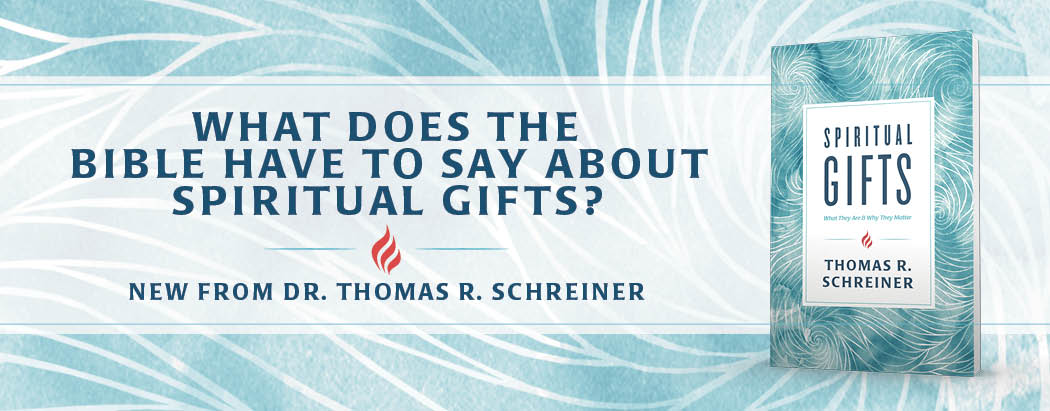
Schreiner, Thomas R. Spiritual Gifts: What They Are and Why They Matter. Nashville: B&H, 2018.

This is an excellent brief introduction to spiritual gifts. The first part of the book presents wise pastoral counsel about what spiritual gifts are and how people should exercise them in the church. The latter part of the book is a brief, winsome defense of the cessationist position.

Schreiner had in the past held to the continuationist position. He comments about his change of mind: “What set me personally back on the road to cesssationism is this very matter of prophecy. I slowly became convinced that the idea that New Testament prophets were different in nature from Old Testament prophets was flawed. Instead, it is more convincing to say that New Testament prophets were infallible like Old Testament prophets” (loc 1681). Like Schreiner, I have always found this (rather than tongues) to be at the heart of the debate.

Schreiner argues that NT prophecy is infallible because there would need to be a clear indication in the NT if prophecy became fallible. To the contrary, the quotation of Joel 2:28 in the NT points to continuity. The NT warnings about false prophets point in the same direction. Second, Ephesians 2:20 teaches that the church was built on the foundation of the apostles and prophets. While Grudem argues that this should be interpreted as “the apostles who are prophets” (thus showing a distinction between infallible and fallible NT prophets), Schreiner notes that Grudem misapplies the Granville Sharp rule to make this claim. Third, the NT demands that prophecies be judged, and the standard laid out in Deuteronomy 18 is that true prophets and prophecies are without error. Fourth, Schreiner rejects that argument that Paul’s claim of apostolic authority over prophets shows that prophets could be in error. “The issue here isn’t whether the words of the prophets are mixed with error. Instead, the issue is whether one is a false prophet!” (loc. 1203). Fifth, Schreiner rejects the claim that the prophecy of Agabus in Acts 21 was in error, noting that Paul in Acts 28 indicates that it was not. Further, Schreiner observes, “if Agabus is judged to be in error, the same kind of judgment could be used to assess other texts which some claim have errors” (loc 1225).

With regard to tongues, Schreiner holds that Acts 2 defines tongues as xenoglossia. None of the following passages in Acts or 1 Corinthians demand that tongues be understood as glossolalia. Thus the claimed gift today is not the same thing as the gift of tongues as practiced in the New Testament.

Filed Under: Biblical Studies, Book Recs, Dogmatics, Pneumatology

Worldview and American Experience’s “The Eugenics Crusade”

November 14, 2018 by Brian

PBS’s American Experience recently aired a two-hour program about eugenics: “The Eugenics Crusade: What’s Wrong with Perfect?”. It is well worth watching.

Eugenics is the textbook example of the problem with placing unquestioning trust in the latest scientific consensus. When Christians raised moral questions about embryonic stem cell research, they were admonished not to let faith stand in the way of progress and science.
Interestingly, Christians were viewed similarly when they raised objections to eugenics.

And it was when these self-identified liberal and modernist religious men abandoned bedrock principles to seek relevance in modern debates that they were most likely to find themselves endorsing eugenics. Those who clung stubbornly to tradition, to doctrine, and to biblical infallibility opposed eugenics and became, for a time, the objects of derision for their rejection of this most modern science.

Christine Rosen, Preaching Eugenics: Religious Leaders and the American Eugenics Movement (New York: Oxford University Press, 2004), 5.

Interestingly, the American Experience documentary did not identify this aspect of eugenics history. It did not distinguish between the social gospel ministers who embraced eugenics (Rosen, 17) and the conservatives who opposed it.

Indeed, the documentary makers framed the issue differently. They repeatedly emphasized that the proponents of eugenics promoted their ideas with religious fervor. Eugenics became to them a religion. The connection between religion and eugenics can even be seen in the title: “The Eugenics Crusade.” On the one hand, I have no problem with framing false ideologies in religious terms. They often are religious in nature. On the other hand, the documentary closed by claiming that better science debunked eugenics.

By eliding the religious opposition to eugenics, and by framing proponents of eugenics in terms of religion, the documentary created a narrative arc in which science triumphed over religion rather than presenting a narrative in which religious wisdom, if heeded, could have prevented oppression in the name of scientific consensus.

The worldview of the program also appeared in its handling of abortion. Abortion was never mentioned in the program. Margaret Sanger did make a brief appearance, but she was presented merely as promoting birth control. Her connection with eugenics, even specifically racist eugenics, was presented as a pragmatic way to promote the liberation of women through birth control. So instead of investigating the link between eugenics and abortion, the documentary seeks to distance them from each other.

The program does accurately convey the degree to which eugenics was in the mainstream of educated opinion for significant period of the early twentieth century, and it intends for viewers to be aghast that such ideas, and their implementation, were accepted so widely by Americans. I can only hope that in a future generation a PBS documentary on abortion will expect its audience to be aghast that abortion was mainstream.

I think this documentary is worth watching, but watch it with an awareness of how the creators’ worldview has shaped, and distorted, the story being told.

Filed Under: Christian Worldview

Two Puritan Books: McGraw on Owen and Watson on the Ten Commandments

November 10, 2018 by Brian

McGraw, Ryan. The Foundation of Communion with God: The Trinitarian Piety of John Owen. Profiles in Reformed Spirituality. Grand Rapids: Reformation Heritage, 2014.

The Profiles in Reformed Spirituality are favorites. They are small books which fit easily into one’s hand or pocket. They begin with a brief biography, but the heart of the books are two-page selections from the featured theologian’s writings. The selections focus on personal piety and one’s walk with God. This volume concludes with a suggested plan for reading Owen’s works.

Watson, Thomas. The Ten Commandments. 1692; Reprinted, Carlisle, PA: Banner of Truth, 1965.

This is the first book I would recommend buying on the Ten Commandments (although Udemans’ The Practice of Faith, Hope, and Love ranks with it). Since this book is derived from sermons it provides both exposition and application of the Decalogue.

As the second volume of Watson’s exposition of the Westminster Shorter Catechism, Watson’s book covers more than the Ten Commandments. He also discusses the questions that relate to sin, salvation, and the ordinances.

Filed Under: Book Recs

Al Wolters on Nature and Grace in Proverbs 31

October 29, 2018 by Brian

Wolters, Albert M. “Nature and Grace in the Interpretation of Proverbs 31:10-31.” Calvin Theological Journal 19, no. 2 (November 1, 1984): 153-166.

In this article, Wolters looks at how different views of the relation between nature and grace have affected the interpretation of Proverbs 31:10-31.

He observes that those who oppose grace to nature tend to allegorize this passage. This was common from Origen through the Middle Ages. Even interpreters who focused on the literal sense, like Nicholas of Lyra, took the allegorical understanding to be the literal sense of this passage. Since Toy, many critical interpreters who assume that ancient Israel held a nature against grace view claim the poem was originally secular.

In the 18th-20th centuries, Catholic writers give a grace above nature interpretation of this passage. On this reading, much of the passage deals with merely natural virtues, but at the end of the poem these are transcended by true fear of God.

Luther exemplifies the grace alongside nature view. Wolters notes that Luther was influential in ending the allegorical interpretation of the passage. But Luther still distinguished grace and nature in this marginal comment to his translation of the passage: “That is to say, a woman can live with a man honourably and piously and can with a good conscience be a housewife, but she must also, in addition and next to this, fear God, have faith and pray.”

Regarding a grace restores nature viewpoint, Wolters says, “Applied to the Song of Proverbs 31, this paradigm fosters an interpretation which looks upon the fear of the Lord as integral to the poem as a whole. Religion is not restricted to verse 30, but pervades the whole… Here the woman’s household activities are seen, not as something opposed to, or even distinct from, her fear of the Lord, but rather as its external manifestation.”

Wolters holds to the fourth view, but he is willing to grant that the “Valiant Woman as the personification of Wisdom—not in an allegorical sense, but in the sense of an earthly embodiment of what it means to be wise.”

Filed Under: Biblical Studies, Dogmatics, Proverbs, Soteriology

Translation Theory: Linguistic vs. Literary

October 8, 2018 by Brian

In the reading that I’ve done on translation theory, I’ve noticed that there is a difference between biblical scholars whose understanding of translation lies largely in a study of linguistics and secular translators who are more literary in orientation.

Thus I found this paragraph in an LA Review of Books article about translation interesting and confirmatory:

St. Jerome famously suggested that one should translate secular works with a “sense for sense” rather than a “word for word” approach, while sacred texts should be approached literally, since “even the order of words” is divinely inspired. Contemporary translation theory in the West reflects this divide, with the positions of sacred and secular flipped. Eugene Nida, an influential force in Bible translation and a pioneer of modern translation studies, argued for finding “dynamic equivalences,” to secure the transmission of meaning across languages (he would sacrifice the letter for the spirit). Ostensibly secular theorists of literary translation like Antoine Berman, Lawrence Venuti, and Emily Apter, on the other hand, argue for translation practices that underscore the foreignness of the source text, and its resistance to assimilation by other cultures (they would risk the spirit for the letter).

V. Joshua Adams, “Translation Without Theory,” LA Review of Books (Oct 7, 2018).

While recognizing that Jerome is probably not saying that biblical translators should maintain the word order of the original Hebrew, Aramaic, and Greek texts (seeing as he did not follow that practice in his own translation work) and that even within a particular translation of the Bible, translators operate on a continuum between formal and functional translations, my sympathies are with the secular theorists of literary translation who argue for maintaining the foreignness of a text.

I sympathize with the literary side of this debate rather than with the linguists because it seems that the linguists sometimes operate too mechanically. The Bible is a literary book that communicates by literary form. For instance, in Genesis 40:15 the translation “dungeon” is not technically inaccurate. A “dungeon” is a pit-like prison. But the more formal translation “pit” is better because it picks up on the literary connection between Genesis 40:15 and 37:24. (And, if Joseph is using the term “pit” figuratively, then dungeon may not be the most accurate translation.)

This is not to say that there is no room for niche translations that bridge the cultural gap for some readers. But one’s standard Bible should allow the reader to enter the world of the Bible text. Given the popularity of study Bibles, it would seem that the ideal place to bridge the cultural gap is not in the translation itself but in study notes.

Filed Under: Uncategorized

Martin Luther’s Bondage of the Will

September 15, 2018 by Brian

Luther, Martin. Career of the Reformer III. In Luther’s Works. Volume 33. Edited by Helmutt Lehmann and Philip S. Watson. Philadelphia: Fortress, 1999. [Bondage of the Will]

The Bondage of the Will is essential reading. Luther believed that Erasmus, to whom he is responding, reached the heart of the Reformation in his critique. It is important to recognize that by bondage of the will Luther does not mean that people do not do what they please. Rather, he means that the will is so bound by sin that people will not choose to come to God apart from the working of God upon their hearts. Luther’s argumentation is both theological and exegetical.

Filed Under: Anthropology, Book Recs, Dogmatics, Soteriology

  • « Previous Page
  • 1
  • …
  • 26
  • 27
  • 28
  • 29
  • 30
  • …
  • 87
  • Next Page »