
Exegesis and Theology

The Blog of Brian Collins

  • About
  • Writings
  • Recommended Resources
  • Categories
    • Christian Living
    • Book Recs
    • Biblical Theology
    • Dogmatics
      • Bibliology
      • Christology
      • Ecclesiology
    • Church History
    • Biblical Studies

When Functional Translations Create Unnecessary Problems

June 23, 2017 by Brian

A few months ago I had a conversation with a friend about harmonizing Ahab’s death in 1 Kings 22:37-38 with the prophecy of his death in 21:19. The prophecy says that dogs will lick up Ahab’s blood in the same place where they licked up Naboth’s blood, which is in Jezreel. 1 Kings 22:37-38, however, indicates that the dogs licked up Ahab’s blood in Samaria. The typical harmonization proposes that Elijah’s prophecy of 21:19 was fulfilled in Ahab’s son (whose body indeed was cast into Naboth’s vineyard). The change is claimed to be due to a mitigation of the punishment brought about by Ahab’s repentance.But 22:37-38 indicates that Ahab’s death was in fulfillment of this prophecy, and 21:29 specifies that it is the ending of Ahab’s dynasty (not how his body is treated after death) that is delayed until Ahab’s son.

My friend proposed that Samaria in 1 Kings 22:37-38 refers to the region rather than to the city. I was skeptical at first. But today I was re-reading these passages and noticed 1 Kings 21:18, in which the Lord says to Elijah:

Arise, go down to meet Ahab king of Israel, who is in Samaria; behold, he is in the vineyard of Naboth, where he has gone to take possession.

We know from 21:1 that Naboth’s vineyard is in Jezreel. So verse 18 is saying that Ahab is both in Samaria and in Jezreel (being in the vineyard of Naboth). For this to be true, Samaria would have to refer to the region, not the city. Since Samaria in giving of the prophecy refers to the region, we would expect that Samaria in the recounting of the prophecy’s fulfillment would also refer to the region (22:37-38). I think that this verse provides support for my friend’s thesis.

Here’s where translation comes into play: the NRSV and NIV provide an interpretive rendering in 21:18, translating “who rules in Samaria” for “who is in Samaria.” They do this, surely, because v. 1 has indicated that Naboth’s vineyard is in Jezreel. They may be seeking to smooth out a potential contradiction between 21:1 and 21:18. But by limiting the interpretive options, the translators foreclose the harmonization of 21:18 and 22:37-38 on the grounds that Samaria in these passages refers to the region rather than the city.

I don’t think, in this case, that the interpretive translation is any easier for the casual reader. He’s going to read over the verse without even thinking that Naboth’s vineyard is in Jezreel rather than Samaria. But for the reader who is attuned to these details, by providing a resolution to one perceived problem (harmonizing 21:1, 18), the translator foreclosed a possible resolution to the harmonization of 22:37-38—and they probably didn’t even realize that they were doing so. I regularly find this with interpretive translations. I often understand why they chose the interpretation they did, but I also often see something of exegetical significance that is lost in moving away from the formal translation. And often these are details that may not have occurred to them in the course of translating. The benefit of a formal translation at these points is that meaning that the translator has not fully grasped can still come through for readers.

Filed Under: Biblical Studies

The Trinity: The Distinctiveness of the Son

June 19, 2017 by Brian

. . . through whom the Father created all things. [Bavinck, RD, 2:269]

John 1:3—All things were made through him, and without him was not any thing made that was made.

1 Corinthians 8:6—yet for us there is one God, the Father, from whom are all things and for whom we exist, and one Lord, Jesus Christ, through whom are all things and through whom we exist.

Colossians 1:15–17—He is the image of the invisible God, the firstborn of all creation. 16 For by him all things were created, in heaven and on earth, visible and invisible, whether thrones or dominions or rulers or authorities—all things were created through him and for him. 17 And he is before all things, and in him all things hold together.

Hebrews 1:3—3 He is the radiance of the glory of God and the exact imprint of his nature, and he upholds the universe by the word of his power. After making purification for sins, he sat down at the right hand of the Majesty on high,

Mediatorship, the atonement, salvation, grace, wisdom, and righteousness pertain to the Son. [Bavinck, RD, 2:270]

Matthew 1:21—She will bear a son, and you shall call his name Jesus, for he will save his people from their sins.

1 Corinthians 1:30—And because of him you are in Christ Jesus, who became to us wisdom from God, righteousness and sanctification and redemption,

Ephesians 1:10–11—as a plan for the fullness of time, to unite all things in him, things in heaven and things on earth. 11 In him we have obtained an inheritance, having been predestined according to the purpose of him who works all things according to the counsel of his will,

1 Timothy 2:5—For there is one God, and there is one mediator between God and men, the man Christ Jesus,

1 Peter 1:2—according to the foreknowledge of God the Father, in the sanctification of the Spirit, for obedience to Jesus Christ and for sprinkling with his blood: May grace and peace be multiplied to you.

1 John 2:2—He is the propitiation for our sins, and not for ours only but also for the sins of the whole world.

Filed Under: Dogmatics, TheologyProper

Sermon on the Mount Resources

May 29, 2017 by Brian

I just completed teaching a Sunday School cycle on the Beatitudes. These were the resources that I used week-by-week.

Gregory of Nyssa, The Lord’s Prayer, The Beatitudes. Ancient Christian Writers. Edited by Johannes Quasten and Jospeh C. Plumpe. Translated by Hilda C. Graef. New York: Paulist, 1954.

Gregory of Nyssa, along with Irenaeus, has become one of my favorite church fathers to read. While he has the typical weaknesses of patristic interpreters, he also is an insightful and practical reader of Scripture. Even at points where I didn’t follow his exegesis, I was often stimulated to work through the passage from an angle I hadn’t thought of before. On a previous occasion I’d worked through the section on the Lord’s Prayer. It too is well worth reading.

Augustine of Hippo. Commentary on the Lord’s Sermon on the Mount with Seventeen Related Sermons. The Fathers of the Church. Edited by Hermigild Dressler. Translated by Denis J. Kavanagh. Washington, DC: Catholic University of America Press, 1951.

This is an early commentary by Augustine, and it is very brief. It could be skipped.

John Chrysostom. “Homilies of St. John Chrysostom, Archbishop of Constantinople on the Gospel according to St. Matthew.” In Saint Chrysostom: Homilies on the Gospel of Saint Matthew. Nicene and Post-Nicene Fathers of the Christian Church, First Series. Edited by Philip Schaff. Translated by George Prevost and M. B. Riddle. New York: Christian Literature Company, 1888.

Brief comments, moderately helpful. I’d still make Gregory of Nyssa my go-to patristic commentator.

Simonetti, Manlio, ed. Matthew 1–13. Ancient Christian Commentary on Scripture. Downers Grove, IL: InterVarsity Press, 2001.

I typically don’t use this series because I’d rather have a full patristic commentary with all of the context rather than snippets chosen by an editor. However, I had this at hand, and I did find selections form an anonymous unfinished commentary on Matthew to be valuable at certain points.

Luther, Martin. The Sermon on the Mount and the Magnificat. Luther’s Works. Edited by Jaroslav Jan Pelikan, Hilton C. Oswald, and Helmut T. Lehmann. Saint Louis: Concordia Publishing House, 1999.

Luther’s comments were usually helpful. He works through difficult problems carefully, and even when I came out at a different point, I found his perspective worth considering.

Calvin, John. Commentary on a Harmony of the Evangelists, Matthew, Mark, and Luke. Translated by William Pringle. 1845; Reprinted, Grand Rapids: Baker, 1996.

Calvin’s comments on the beatitudes are brief. They are fine, but I found more help from the Puritan authors.

Perkins, William. “A Godly and Learned Exposition of Christ’s Sermon on the Mount [1608].” In The Works of Willima Perkins. Volume 1. Edited by Joel R. Beeke, Derek W. H. Thomas, and J. Stephen Yuille. Grand Rapids: Reformation Heritage, 2014.

This is a phenomenal exposition. It lives up to its title. It is a learned exposition. There were points were its definition of key terms in the Beatitudes could not be bettered. And it is a godly exposition. Perkins provides not only exegesis but application, and his application is helpful even at the present. I wouldn’t want to teach the Sermon on the Mount without this volume.

Watson, Thomas. The Beatitudes: An Exposition of Matthew 5:1-10. 1660; Reprinted, Carlisle, PA: Banner of Truth, 2014.

If Thomas Watson has written it, read it. This may have been the most helpful of all the resources that I drew on for this study. I didn’t always agree with Watson’s exegesis, but I often did. Watson also exemplifies the Puritan familiarity with the entire Bible and the Puritan method of categorizing. For instance, on “Blessed are they who mourn,” Watson ransacks the entire Bible for references to mourning and categorizes various kinds of sinful mourning and various kinds of righteous morning. He also gives searching applications of the passages.

Broadus, John A. Matthew. American Commentary. Edited by Alvah Hovey. 1886; Reprinted, Valley Forge: Judson Press, n.d.

I like Broadus, but I didn’t find him especially helpful for this particular study.

Bonhoeffer, Dietrich. The Cost of Discipleship. 1937; Reprinted, New York: Simon & Schuster, 1995.

I looked at this resource more to familiarize myself with Bonhoeffer and less as a resource for this study. I didn’t find him especially helpful.

Lloyd-Jones, D. Martyn. Studies in the Sermon on the Mount. Grand Rapids: Eerdmans, 1959, 1960.

These are printed sermons, so the coverage is a bit uneven. Often the description of the blessed people receives more coverage than the blessings. But this is a helpful resource worth consulting.

Carson, D. A. Jesus’ Sermon on the Mount and His Confrontation with the World: An Exposition of Matthew 5-10. 1978, 1987; Reprinted, Grand Rapids: Baker, 1999.

I find this a helpful resource to read alongside Carson’s Matthew commentary. Since he’s focused on a section of Matthew and since these are published sermons there is a helpful expansion beyond what is given in the commentary.

Guelich, Robert A. The Sermon on the Mount: A Foundation for Understanding. Waco: Word, 1982.

Guelich has a host of critical assumptions that I don’t share. And the format of this commentary is akin to that of the Word Biblical Commentary, so that one has to flip to various sections to find all of his comments on a particular verse. Nonetheless, I found his lexical discussions and his treatment of parallel passages in both the OT and NT helpful.

Carson, D. A. “Matthew.” in Expositor’s Bible Commentary. Volume 8. Edited by Frank E. Gaebelein. Grand Rapids: Zondervan, 1984.

This study confirmed my previous impressions that Carson’s commentary on Matthew is among the very best Matthew commentaries. He is concise, but he was again and again the most helpful recent commentator on each beatitude. He also makes connections with OT passages that Jesus was alluding to. If I were to use only one modern commentary on Matthew for this study, this would be it.

Stott, John R. W. The Message of the Sermon on the Mount (Matthew 5-7): Christian Counter-Culture. The Bible Speaks Today. Edited by John R. W. Stott. Leicester; Downers Grove, IL: InterVarsity Press, 1985.

Stott’s exposition is on point and helpful. If I hadn’t been drawing on Perkins and Watson as much, I probably would have drawn on Stott more. This would be a good commentary to recommend if someone was wanting to read a brief commentary along with Sermon.

Blomberg, Craig L. Matthew. New American Commentary. Edited by David S. Dockery. Nashville: Broadman, 1992. 

I’ve regularly found Blomberg to have unique and valuable insights in this commentary despite its brevity. However, though I often agreed with his interpretations of the Beatitudes, he was so brief that he wasn’t giving me anything that I hadn’t already picked up from other sources.

Morris, Leon. The Gospel according to Matthew. The Pillar New Testament Commentary. Edited by D. A. Carson. Grand Rapids: Eerdmans, 1992.

Morris’s commentary is fine. But I typically find that though he is more verbose than Carson, he ends up saying less.

Allison, Dale C. The Sermon on the Mount: Inspiring the Moral Imagination. New York: Herder & Herder, 1999.

I couldn’t afford the three volume ICC set by Davies and Allison this time around, so I picked up this slim volume by Allison instead. Allison writes from a critical perspective, but he is also interested in the history of interpretation. I found him helpful at several points.

Nolland, John. The Gospel of Matthew: A Commentary on the Greek Text. New International Greek Testament Commentary. Edited by I. Howard Marshall and Donald A. Hagner. Grand Rapids: Eerdmans, 2005.

I’ve had a poor opinion of this commentary based on brief encounters flipping through it in bookstores. But in this study of the Beatitudes, I’d rank him right up with Carson as one of the most helpful modern commentators. I thought his interpretations were typically on point, and his connections with OT material that lay behind Jesus’s sermon were helpful.

France, R. T. The Gospel of Matthew. New International Commentary on the New Testament. Edited by Gordon D. Fee. Grand Rapids: Eerdmans, 2007.

I was expecting France to be among the most helpful recent commentators. He did have a superb discussion of what “blessed” means. But his discussions of the individual beatitudes were not as helpful as Carson, Nolland, or Luz.

Luz, Ulrich. Matthew 1–7. Revised edition. Hermeneia. Edited by Helmut Koester. Minneapolis, MN: Fortress Press, 2007.

Though not conservative, Luz is helpful in providing cross references and surveys of the history of how the verses have been interpreted.

Turner, David L. Matthew. Baker Exegetical Commentary on the New Testament. Edited by Robert W. Yarbrough and Robert H. Stein. Grand Rapids: Baker, 2008.

I’m routinely disappointed by this commentary. For its size it doesn’t say much.

Keener, Craig S. The Gospel of Matthew: A Socio-Rhetorical Commentary. Grand Rapids: Eerdmans, 2009.

Keener’s treatment of the beatitudes is fairly brief. I expect he’ll be more helpful on other passages in Matthew.

Filed Under: Book Recs

The Trinity: The Distinctiveness of the Father

May 26, 2017 by Brian

The passages below are gathered largely, but probably not exclusively, from Bavinck. There are a few cases where I’m not sure Bavinck has interpreted/classified the passage correctly, but I’ve still left those passages in the listing as worthy of consideration.

God’s fatherhood of the Son is his particular personal attribute. He alone is of himself, the first in the order of existence (John 5:26) and hence the Father both in creation and re-creation, from whom all things exist (1 Cor. 8:6). [Bavinck, RD, 2:272.]

Uniquely the Father of the Son

In a unique metaphysical sense God is the father of his Son. Jesus consistently makes an essential distinction between the relation in which he himself, and that in which others—the Jews, the disciples—stand to the Father. [Bavinck, RD, 2:272.]

Matthew 11:25–27—25 At that time Jesus declared, “I thank you, Father, Lord of heaven and earth, that you have hidden these things from the wise and understanding and revealed them to little children; 26 yes, Father, for such was your gracious will. 27 All things have been handed over to me by my Father, and no one knows the Son except the Father, and no one knows the Father except the Son and anyone to whom the Son chooses to reveal him.

Luke 22:29—and I assign to you, as my Father assigned to me, a kingdom,

John 2:16—16 And he told those who sold the pigeons, “Take these things away; do not make my Father’s house a house of trade.”

John 5:17—But Jesus answered them, “My Father is working until now, and I am working.”

John 5:18–24—This was why the Jews were seeking all the more to kill him, because not only was he breaking the Sabbath, but he was even calling God his own Father, making himself equal with God. So Jesus said to them, “Truly, truly, I say to you, the Son can do nothing of his own accord, but only what he sees the Father doing. For whatever the Father does, that the Son does likewise. For the Father loves the Son and shows him all that he himself is doing. And greater works than these will he show him, so that you may marvel. For as the Father raises the dead and gives them life, so also the Son gives life to whom he will. For the Father judges no one, but has given all judgment to the Son, that all may honor the Son, just as they honor the Father. Whoever does not honor the Son does not honor the Father who sent him. Truly, truly, I say to you, whoever hears my word and believes him who sent me has eternal life. He does not come into judgment, but has passed from death to life.

John 14:6–13—Jesus said to him, “I am the way, and the truth, and the life. No one comes to the Father except through me. If you had known me, you would have known my Father also. From now on you do know him and have seen him.” Philip said to him, “Lord, show us the Father, and it is enough for us.” Jesus said to him, “Have I been with you so long, and you still do not know me, Philip? Whoever has seen me has seen the Father. How can you say, ‘Show us the Father’? Do you not believe that I am in the Father and the Father is in me? The words that I say to you I do not speak on my own authority, but the Father who dwells in me does his works. Believe me that I am in the Father and the Father is in me, or else believe on account of the works themselves. “Truly, truly, I say to you, whoever believes in me will also do the works that I do; and greater works than these will he do, because I am going to the Father. Whatever you ask in my name, this I will do, that the Father may be glorified in the Son.

John 17:25–26—O righteous Father, even though the world does not know you, I know you, and these know that you have sent me. 26 I made known to them your name, and I will continue to make it known, that the love with which you have loved me may be in them, and I in them.”

John 20:17—Jesus said to her, “Do not cling to me, for I have not yet ascended to the Father; but go to my brothers and say to them, ‘I am ascending to my Father and your Father, to my God and your God.’ ”

Romans 15:6—that together you may with one voice glorify the God and Father of our Lord Jesus Christ.

1 Corinthians 15:24—Then comes the end, when he delivers the kingdom to God the Father after destroying every rule and every authority and power.

2 Corinthians 1:3—Blessed be the God and Father of our Lord Jesus Christ, the Father of mercies and God of all comfort,

Galatians 1:1—Paul, an apostle—not from men nor through man, but through Jesus Christ and God the Father, who raised him from the dead—

Ephesians 1:1—Paul, an apostle of Christ Jesus by the will of God, To the saints who are in Ephesus, and are faithful in Christ Jesus:

The Father as Creator of All Things

The Father is “the Creator of all things . . . . All things derive their existence form him.” (Bavinck, RD, 2:269).

In its most general sense, this name [Father] refers to God as the creator of all his works, especially of humankind. [Bavinck, RD, 2:272]

Numbers 16:22—And they fell on their faces and said, “O God, the God of the spirits of all flesh, shall one man sin, and will you be angry with all the congregation?”

Matthew 7:11— If you then, who are evil, know how to give good gifts to your children, how much more will your Father who is in heaven give good things to those who ask him!

Luke 3:38—the son of Enos, the son of Seth, the son of Adam, the son of God.

Acts 17:28—28 for “ ‘In him we live and move and have our being’; as even some of your own poets have said, “ ‘For we are indeed his offspring.’

1 Corinthians 8:6—yet for us there is one God, the Father, from whom are all things and for whom we exist, and one Lord, Jesus Christ, through whom are all things and through whom we exist.

Ephesians 3:15—from whom every family in heaven and on earth is named,

Hebrews 12:9—Besides this, we have had earthly fathers who disciplined us and we respected them. Shall we not much more be subject to the Father of spirits and live?

The Father’s Foreknowledge, Election, Power, Love, and Kingdom

The ‘good pleasure,’ the foreknowledge, the election, the power, the love, and the kingdom all belong to the Father. [Bavinck, RD, 2:270.]

Matthew 6:13—And lead us not into temptation, but deliver us from evil.

Matthew 11:26—yes, Father, for such was your gracious will.

John 3:16—“For God so loved the world, that he gave his only Son, that whoever believes in him should not perish but have eternal life.

Romans 8:29—For those whom he foreknew he also predestined to be conformed to the image of his Son, in order that he might be the firstborn among many brothers.

Ephesians 1:9—making known to us the mystery of his will, according to his purpose, which he set forth in Christ

1 Peter 1:2—according to the foreknowledge of God the Father, in the sanctification of the Spirit, for obedience to Jesus Christ and for sprinkling with his blood: May grace and peace be multiplied to you.

Creator of Israel

God is Israel’s father inasmuch as he created and preserved his people by his marvelous power. Bavinck, RD, 2:272

Deuteronomy 32:6—Do you thus repay the LORD, you foolish and senseless people? Is not he your father, who created you, who made you and established you?

Isaiah 63:16—For you are our Father, though Abraham does not know us, and Israel does not acknowledge us; you, O LORD, are our Father, our Redeemer from of old is your name.

Isaiah 64:8—But now, O LORD, you are our Father; we are the clay, and you are our potter; we are all the work of your hand.

Malachi 1:6—“A son honors his father, and a servant his master. If then I am a father, where is my honor? And if I am a master, where is my fear? says the LORD of hosts to you, O priests, who despise my name. But you say, ‘How have we despised your name?’

Malachi 2:10—Have we not all one Father? Has not one God created us? Why then are we faithless to one another, profaning the covenant of our fathers?

Jeremiah 3:19—“ ‘I said, How I would set you among my sons, and give you a pleasant land, a heritage most beautiful of all nations. And I thought you would call me, My Father, and would not turn from following me.

Jeremiah 31:9—With weeping they shall come, and with pleas for mercy I will lead them back, I will make them walk by brooks of water, in a straight path in which they shall not stumble, for I am a father to Israel, and Ephraim is my firstborn.

Romans 9:4—They are Israelites, and to them belong the adoption, the glory, the covenants, the giving of the law, the worship, and the promises.

God as Father of Believers in an Ethical Sense

In the New testament this meaning [of the name Father] changes into the ethical one in which God is the father of his children. Bavinck, RD, 2:272

Matthew 6:4—so that your giving may be in secret. And your Father who sees in secret will reward you.

Matthew 6:8–9—Do not be like them, for your Father knows what you need before you ask him. 9 Pray then like this: “Our Father in heaven, hallowed be your name.

Romans 8:15—For you did not receive the spirit of slavery to fall back into fear, but you have received the Spirit of adoption as sons, by whom we cry, “Abba! Father!”’

Concluding Thought

Both in the Old and in the New Testament, God is the Father who occupies first place. His is the purpose (Acts 4:28; Eph 1:11), the good pleasure (Matt. 11:26; Eph. 1:9), the initiative in creation and re-creation (Ps 33:6; John 3:16), the kingdom and the power (ἐξουσια, δυναμις, Matt. 6:13 KJV; Rom. 3:26; 2 Tim. 4:8), the righteousness (Gen. 18:25; Deut. 32:4; John 17:25; Rom. 3:26; 2 Tim. 4:8), the goodness, wisdom, immortality, unapproacble light (Matt. 19:17; Rom. 16:27; 1 Tim. 6:16). He, accordingly, regularly bears the name ‘God’ in a special sense. He is Elohim, YHWH Elohim, El Elyon, El Shaddai, the one true God (μονος ἀληθινος θεος, John 17:3), the one God (ἐις θεος, 1 Cor. 8:6; 1 Tim. 2:5), who is mentioned as God and Father alongside the Lord Jesus Christ and the Holy Spirit (1 Cor. 12:6; 2 Cor. 13:13; 1 Thess. 1:3; Rev. 1:6) Even Christ not only calls him his Father but also his God (Matt. 27:46; John 20:17; Heb. 1:9; 2:17; 5:1; 10:7, 9) and is himself called ‘the Christ of God’ (Luke 9:20; 1 Cor. 3:23; Rev. 12:10). [Bavinck, RD, 2:272.]

Filed Under: Dogmatics, TheologyProper

The Trinity: The Unity of the Triune God

May 24, 2017 by Brian

I believe a began gathering these passages under these categories by looking first at Bavinck’s Reformed Dogmatics, but this has probably been supplemented from other sources as well over time. Scripture is quoted from the ESV.

There is only One God

Deuteronomy 6:4—“Hear, O Israel: The Lord our God, the Lord is one.

Isaiah 44:8—Fear not, nor be afraid; have I not told you from of old and declared it? And you are my witnesses! Is there a God besides me? There is no Rock; I know not any.”

Isaiah 45:21—Declare and present your case; let them take counsel together! Who told this long ago? Who declared it of old? Was it not I, the LORD? And there is no other god besides me, a righteous God and a Savior; there is none besides me.

John 17:3—And this is eternal life, that they know you the only true God, and Jesus Christ hom you have sent.

1 Corinthians 8:4—Therefore, as to the eating of food offered to idols, we know that “an idol has no real existence,” and that “there is no God but one.”

Ontological Unity of the Three Persons

John 10:30—30 I and the Father are one.” (see John 10:33, 38)

Matthew 28:19—19 Go therefore and make disciples of all nations, baptizing them in the name of the Father and of the Son and of the Holy Spirit,

“And just as Jesus finally sums up his instruction in the name of the Father, of the Son, and of the Holy Spirit, so also the apostles again and again put these names side by side and on the same level.” [Bavinck, RD, 2:270.]

1 Corinthians 8:6—6 yet for us there is one God, the Father, from whom are all things and for whom we exist, and one Lord, Jesus Christ, through whom are all things and through whom we exist.

1 Corinthians 12:4–6—4 Now there are varieties of gifts, but the same Spirit; 5 and there are varieties of service, but the same Lord; 6 and there are varieties of activities, but it is the same God who empowers them all in everyone.

2 Corinthians 13:14—14 The grace of the Lord Jesus Christ and the love of God and the fellowship of the Holy Spirit be with you all.

2 Thessalonians 2:13–14—13 But we ought always to give thanks to God for you, brothers beloved by the Lord, because God chose you as the firstfruits to be saved, through sanctification by the Spirit and belief in the truth. 14 To this he called you through our gospel, so that you may obtain the glory of our Lord Jesus Christ.

Ephesians 4:4–6—4 There is one body and one Spirit—just as you were called to the one hope that belongs to your call— 5 one Lord, one faith, one baptism, 6 one God and Father of all, who is over all and through all and in all.

1 Peter 1:2—2 according to the foreknowledge of God the Father, in the sanctification of the Spirit, for obedience to Jesus Christ and for sprinkling with his blood: May grace and peace be multiplied to you.

1 John 5:4–6—4 For everyone who has been born of God overcomes the world. And this is the victory that has overcome the world—our faith. 5 Who is it that overcomes the world except the one who believes that Jesus is the Son of God? 6 This is he who came by water and blood—Jesus Christ; not by the water only but by the water and the blood. And the Spirit is the one who testifies, because the Spirit is the truth.
Revelation 1:4–6—4 John to the seven churches that are in Asia: Grace to you and peace from him who is and who was and who is to come, and from the seven spirits who are before his throne, 5 and from Jesus Christ the faithful witness, the firstborn of the dead, and the ruler of kings on earth. To him who loves us and has freed us from our sins by his blood 6 and made us a kingdom, priests to his God and Father, to him be glory and dominion forever and ever. Amen.

Unity of Purpose and Action Among the Persons of the Trinity

Luke 1:35—35 And the angel answered her, “The Holy Spirit will come upon you, and the power of the Most High will overshadow you; therefore the child to be born will be called holy—the Son of God.

Matthew 3:16–17—16 And when Jesus was baptized, immediately he went up from the water, and behold, the heavens were opened to him, and he saw the Spirit of God descending like a dove and coming to rest on him; 17 and behold, a voice from heaven said, “This is my beloved Son, with whom I am well pleased.” || Mark 1:10-11; Lk 3:21-22

John 5:26—26 For as the Father has life in himself, so he has granted the Son also to have life in himself.

1 Corinthians 12:4–6—4 Now there are varieties of gifts, but the same Spirit; 5 and there are varieties of service, but the same Lord; 6 and there are varieties of activities, but it is the same God who empowers them all in everyone.

Filed Under: Dogmatics, TheologyProper

Owen on slight thoughts of sin

May 23, 2017 by Brian

He that hath slight thoughts of sin had never great thoughts of God. Indeed, men’s undervaluing of sin ariseth merely from their contempt of God.

John Owen, “An Exposition Upon Psalm CXXX,” in Works, 6: 394.

Filed Under: Uncategorized

A Reformation 500 Read: Luther’s Works, Volume 32

May 16, 2017 by Brian

Forell, George W., ed. Career of the Reformer II. Luther’s Works. Volume 32. Edited by Helmut T. Lehmann. Philadelphia: Fortress, 1958.

Volume 32 of Luther’s Works (along with volume 31, which includes the 95 Theses) is an ideal volume to read on 500th anniversary of the Reformation. It includes the account of Luther at the Diet of Worms, his point-by-point response to the bull, Exsurge Domine,  promulgated against Luther by Pope Leo X, and Luther’s account of the burning of Dutch reformer, Brother Henry, for the faith.

Filed Under: Church History, Uncategorized

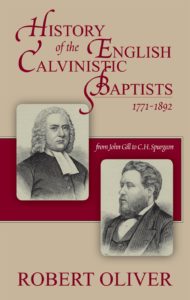
History of the English Calvinistic Baptists from John Gill to C. H. Spurgeon by Robert Oliver

May 10, 2017 by Brian

HistEngCalBaptistsOliver, Robert. History of the English Calvinistic Baptists, 1771-1892: From John Gill to C. H. Spurgeon. Carlisle PA: Banner of Truth, 2006.

Sometimes the best way to learn doctrine is through historical studies. The historical narrative lends interest. But more than that it provides context for why certain positions were held and how they changed and developed over time. This particular volume provides a good introduction to the issues of hyper-Calvinism vs. the free offer of the gospel, antinomianism, the eternal Sonship of Christ, ad open or closed communion.

It also provides good biographical sketches not only of well-known Baptists such as Gill, the Rylands, Fuller, and Spurgeon but also of lesser known men such as Benjamin Beddome or Abraham Booth. For someone interested in reading Baptist primary sources, this book is a good place to get reading ideas.

The history here is carefully done. The book is based on the author’s dissertation. But it has the warmth one would expect from a Banner book.

Filed Under: Uncategorized

Some Thoughts on the Problem of Evil

April 28, 2017 by Brian

Unfortunately, many atheistic attacks on theistic systems for their alleged inadequacy in handling evil amount to nothing more than a rejection of the theist’s account of God, evil, or freedom. It is legitimate for an atheist to claim that that the theistic account of these items is inadequate. It is illegitimate, however, for the atheist to claim that a theist cannot solve his problem of evil on such a basis. If the theist, on his own views, can resolve he problem of evil generated by his system, then his system is internally consistent, regardless of whether the atheist or other theists like the intellectual commitments of the system.

John Feinberg, “Evil, Problem of,” Evangelical Dictionary of Theology, 387

We need to sharpen our sense of proportion. It would be nice to have a solution to the problem of evil, but not at any price. If the price we must pay is the very sovereignty of God, the faithful Christian must say that price is too high. After all, it of little importance whether any of us discovers the answer to the problem of evil. It is possible to live a long and happy and faithful life without an answer. But it is all-important that we worship the true God, the God of Scripture. Without him, human life is worth nothing.

John Frame, Apologetics for the Glory of God, 154.

Filed Under: Dogmatics, TheologyProper

Epistemology and the Avoidance of Deep Questions

April 27, 2017 by Brian

Something worth thinking about:

Tocqueville cares little for ancient metaphysics, yet he cares less for its modern substitute, epistemology, which is designed to protect liberalism from dangerous involvement in deep questions.

Harvey C. Mansfield and Delba Winthrop, “Editor’s Introduction,” in Alexis de Tocqueville, Democracy in America, trans. and ed. Harvey C. Mansfield and Delba Winthrop (Chicago: University of Chicago Press, 2000), xxxi.

Filed Under: Uncategorized

  • « Previous Page
  • 1
  • …
  • 35
  • 36
  • 37
  • 38
  • 39
  • …
  • 87
  • Next Page »