
Mansfield, Harvey C. Tocqueville: A Very Short Introduction. New York: Oxford University Press, 2010.
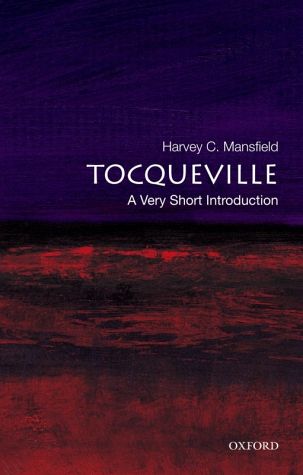 This excellent “Very Short Introduction” is written by one of the translators of the excellent University of Chicago Press edition of Tocqueville’s Democracy in America.
Mansfield, in a brief span of pages is able to distil Tocqueville’s thought, relate it to that of other thinkers, and to show the significance of the questions Tocqueville raises.
Some examples:
Here is another singular feature of his liberalism. Whereas john Stuart Mill, a more typical liberal, does his best to defend the value of individuality in not conforming to majority opinion, Tocqueville expands on the benefits for liberal society of associating. He is less confident than Mill that individuals can be taught to stand up to the majority, and he wants also to persuade the majority that it need not demand conformity. [25]
In noting American reliance on self-interest, Tocqueville differs from much current discussion on democratic participation, sometimes called ‘communitarian.’ Communitarian sentiment is opposed to self-interest; it wants to be altruistic and selfless, for the common good as opposed to selfish or market-oriented. For him, sentiment on behalf of the community comes out of one’s self-interest and is useful to it rather than selfless and opposed. [26]
Religion is the root of the mores that help maintain a democratic republic in America. It is considered for this function, not for its truth—and he says that what is most important is not that all citizens profess the true religion, but that they profess a religion. In this political view, religion serves politics, rather than politics serving religion, as with the Puritans. [30]
Almost immediately after introducing majority tyranny, Tocqueville speaks of the ‘power that the majority exercises over thought.’ He makes the flat statement that ‘I do not know any country where, in general, less independence of mind and genuine freedom reign than in America. It is not that a dissident need fear being persecuted or burned at the stake, but that nobody will listen, and he will be dismissed from consideration, finally shushed. This is an ‘intellectual’ violence that closes the mind and, more effectually than the Inquisition, takes away from authors even the thought of publishing views contrary to the majority’s opinion. [45-46].
“Equality develops the desire in each man to judge everything by himself; it gives him in all things a taste for the tangible and real and a contempt for traditions and forms.” In the permanent bustle of democracy men have no leisure for the quiet meditation required for the “most theoretical principles.” [64]
At the end of his master work Tocqueville discloses the political evil toward which democracy naturally tends, the culmination of his fear, repeatedly expressed, that democratic equality will overcome democratic freedom. Here, he calls this evil ‘mild despotism’; elsewhere he calls it democratic or administrative despotism….We have seen the germ of mild despotism in his description in volume 1 of the vague power of public opinion, but in volume 2 we see it embodied in the centralized democratic state. [77-78]
As these quotations show Tocqueville both has insights that remain relevant to life today (e.g., above quotations from pp. 25, 46-46, 77-78) and ideas that Christians must reject (e.g., quotations form pp. 26, 30).
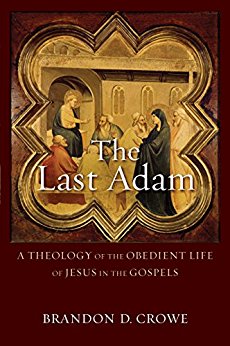
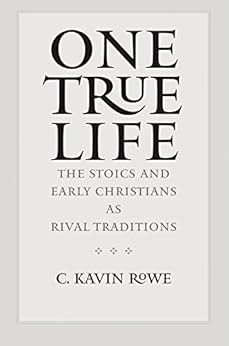 This is one of those books that stands head and shoulders above other recent books. It comes in three parts. In Part I Rowe examines the Stoic philosophers Seneca, Epictetus, and Marcus Aurelius. In Part II Rowe summarizes the thought of Paul, Luke, and Justin Martyr. In Part III Rowe investigates the question of whether these two rival traditions can be compared.
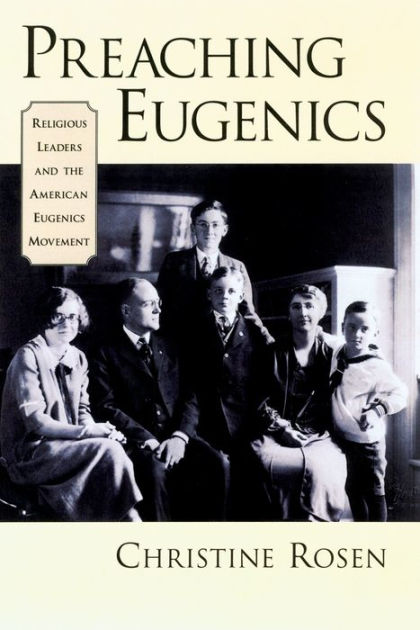 Certain kinds of religious leader gravitated toward eugenics in the early twentieth century, ministers anxious about the changing culture but also eager to find solutions to its diagnosable ills. Theirs was a practical spirituality better understood in terms of worldviews than theologies. Many of the religious leaders who joined the eugenics movement were well-known, even notorious, for their lack of coherent doctrinal vision; of one Congregationalist advocate for eugenics it was said, “He is not a theologian in the ordinary sense, for he loves flowers more than botany.” Of another, a well-known Baptist minister, one critic noted the impossibility of constructing even a preliminary image of his beliefs: “No painter who ever lived could make a picture which expressed the religion of the Rev. Harry Emerson Fosdick.”