
Exegesis and Theology

The Blog of Brian Collins

  • About
  • Writings
  • Recommended Resources
  • Categories
    • Christian Living
    • Book Recs
    • Biblical Theology
    • Dogmatics
      • Bibliology
      • Christology
      • Ecclesiology
    • Church History
    • Biblical Studies

Progressive Covenantalism and the Land: Making Land Relevant (Part 1)

March 21, 2017 by Brian

The promises of the Abrahamic covenant are often summarized under the headings of land, seed, and blessing. In finding the relevance of this covenant to ourselves, we often know what to do with seed and blessing. We know from the New Testament that the Seed is ultimately Christ (Gal. 3:16). Genesis 12 says that Abraham would mediate blessing to all the families of the earth, and we see this fulfilled in salvation through Christ. Christ is the Seed of Abraham, and Jews, also the seed of Abraham, brought the gospel to the Gentiles.

But the relevance of the land promise is not so clear. At first read the New Testament seems to say little regarding the land promise. In addition, the promise of land does not sound spiritual. Nonetheless the land promise is one of the central promises of a foundational covenant. Its significance cannot be dismissed.There are a number of ways in theologians have developed the land promise theme in Scripture.

Spiritualizing the Land

Some interpreters spiritualize the land theme. They claim that the land theme has been spiritualized, often saying that Christ replaces the land.

Dale Allison writes, “Christ’s ubiquity as a spiritual presence universalizes the notion of holy space and so inescapably relativizes the sanctity and significance of the land promised to Abraham’s descendants.”*

Peter Walker claims, “We can already see at least four different New Testament analogues for the land: heaven, the world, Christ himself and Christian fellowship. A creative biblical theology will have room for each where it is appropriate, and will not force the biblical material into one channel to the exclusion of others.”**

Christopher Wright summarizes his viewpoint:

So then by incorporation into the Messiah, all nations are enabled to enter upon the privileges and responsibilities of God’s people. Christ himself takes over the significance and function of the land kinship qualification. ‘In Christ,’ answering to ‘in the land,’ denotes a status and a relationship, a position of inclusion and security, a privilege with attendant responsibilities. This is the typological understanding which was referred to briefly in the Introduction. But what then has become of the socio-economic dimension of the land which we found to have been of such importance in Old Testament Israel? Has it simply been transcended, as spiritualized and forgotten? By no means. . . . The oneness of believers in Christ and their shared experience of Christ is no mere abstract ‘spiritual’ concept. On the contrary, it has far-reaching practical implications in the social and economic realms, both of which are included in the New Testament understanding and practice of ‘fellowship.’***

This approach falters on the significance of physical land in the Bible’s storyline.

* D. C. Allison, Jr., “Land in Early Christianity,” in Dictionary of the Later New Testament and Its Developments, ed. Ralph P. Martin and Peter H. Davids (Downers Grove: InterVarsity, 1997), 644.

** Peter W. L. Walker. “The Land and Jesus Himself,” in The Land of Promise: Biblical, Theological and Contemporary Perspectives (Downers Grove: InterVarsity, 2000), 117-18.

*** Christopher J. H. Wright, God’s People in God’s Land: Family, Land and Property in the Old Testament (Grand Rapids: Eerdmans, 1990), 111-12.

Land Promsise Universalized

Others claim that the land promise has been universalized to encompass the entire creation in such a way that the specific promises to Israel are relativized or superseded.

D. A. Carson takes this view in his comments on Matthew 5:5:

There is no need to interpret the land metaphorically, as having no reference to geography or space; nor is there need to restrict the meaning to ‘land of Israel’…. Entrance into the Promised Land ultimately became a pointer toward entrance into the new heaven and the new earth (‘earth’ is the same word as ‘land’; cf. Isa 66:22; Rev. 21:1), the consummation of the messianic kingdom. . . . Matthew directs our attention … to the ‘renewal of all things’ (19:28).”*

David Holwerda comments:

[T]he horizons of the land have been shaped by the revelation of Jesus Christ. His previous Jewish focus on a particularistic fulfillment has been transformed into a Christian universalism focused on the new creation. Just as in Christ the temple had become a universal dwelling place and the seed of Abraham had been transformed into a universal people, so the promise of the land already embraces the world.**

Thus,

[O]ne may conclude that the original land of Canaan and the city of Jerusalem were only an anticipatory fulfillment of God’s promise. As such they function in Scripture as a sign of the future universal city on the renewed earth, the place where righteousness dwells.**

N. T. Wright argues:

Jesus seems to have said and done remarkably little on the subject of the Land. As we saw in the previous chapter, what he did say served to undermine adherence to land as a major symbol within the Jewish worldview. He moved freely—and announced the kingdom—not only within Galilee but within the largely gentile Decapolis. . . . He seems to have been well aware of the geographical symbolism of Jerusalem, not least in its relation to Galilee; but, as far as he was concerned, one of the main significances of Jerusalem was that it was the city where prophets were killed. His sense of location corresponded, it seems, to his sense of identity and, as we shall see, of timing and purpose. He had not come to rehabilitate the symbol of holy land, but to subsume it within a different fulfilment of the kingdom, which would embrace the whole creation—from which, of course, he drew continually in the narratives and imagery of his teaching and announcement.***

O. Palmer Robertson holds that the land in the old covenant was the shadow of the new covenant reality of the earth as the promised land. Thus the land promise is not to be connected to ethnic or national Israel.****

* D. A. Carson, “Matthew,” in Expositor’s Bible Commentary, ed. Frank E. Gaebelein (Grand Rapids: Zondervan, 1984), 136.

**David E. Holwerda, Jesus and Israel: One Covenant or Two? (Grand Rapids: Eerdmans, 1995), 104, 112.

*** N. T. Wright, Jesus and the Victory of God, Christian Origins and the Question of God (London: SPCK, 1996), 445.

**** O. Palmer Robertson, The Israel of God: Yesterday, Today, and Tomorrow (Phillipsburg, NJ: P&R, 2000), 25, 31, 38.

Progressive Covenantalism and the Land

Progressvie Covenantalists Peter Gentry, Stephen Wellum, and Oren Martin have done much in recent years to argue for and to flesh out the latter proposal.* I would agree with Progressive Covenantalism and those with similar views (e.g., Carson Holwerda) in their rejection of interpretations that spiritualize the land. I would also agree that the land theme in Scripture expands to encompass the entire new earth. However, I do not think that this expansion of the land theme cancels out specific promises given to the nation of Israel regarding land.

*Peter J. Gentry and Stephen J. Wellum, Kingdom through Covenant: A Biblical Understanding of the Covenants (Wheaton: Crossway, 2012); Oren R. Martin, Bound for the Promised Land: The Land Promise in God’s Redemptive Plan, New Studies in Biblical Theology, ed. D. A. Carson (Downers Grove: InterVarsity, 2015); Stephen J. Wellum and Brent E. Parker, eds., Progressive Covenantalism: Charting a Course between Dispensational and Covenantal Theologies (Nashville: B&H, 2016).
Filed Under: Biblical Theology

Review of Gonzalez, Story of Christianity, Volume 2

March 20, 2017 by Brian

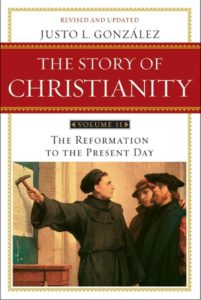
s-l1000-1Gonzalez, Justo L. The Story of Christianity: The Reformation to the Present Day. Revised edition. New York: HarperOne, 2010.
The coverage of the Reformation in this volume is good, but many other areas suffer from serious defects. For instances, the coverage of Protestant Orthodoxy still follows the older neo-orthodox historiography and fails to reckon with the scholarship of Richard Muller and others. The coverage of fundamentalism does not take into account the work of George Marsden. With regard to recent church history, evangelical history is given minimal attention while a great deal of attention is given to the ecumenism and liberation theology. I found the coverage of Vatican II and the World Council of Churches helpful, but as the book moves toward the end Gonzalez’s own theological predilections become clearer in ways not entirely fitting for a broad-scale historical survey of church history.

Filed Under: Book Recs, Church History

The Sermon on the Mount in James

March 17, 2017 by Brian

Porter, Virgil V. “The Sermon on the Mount in the Book of James, Part 1,” BibSac 162, no. 647 (July-Sept. 2005): 344-60.

This article contains a helpful chart of all the verbal parallels between the Sermon on the Mount and the Book of James. It also highlights shared topics: law, wealth and poverty, speech, prayer, trials, temptation, perfection, wisdom and folly, judgment, righteousness, people (this list is drawn from the article’s section headings). Part 2, which I did not read, covers parallels organized by the categories of systematic theology.

Filed Under: Biblical Studies, Book Recs, James, Matthew

Peter Gurry on Changes in Textual Criticism

March 16, 2017 by Brian

Gurry, Peter J. “How Your Greek NT Is Changing: A Simple Introduction to the Coherence-Based Genealogical Method (CBGM),” JETS 59, no. 4 (2016): 675-89.

This is a readable article on a new method in textual criticism, perhaps most notable for being employed in the General Epistles in the NA and UBS texts. Helpfully, he includes an index to discussions of variant readings in the General Epistles where CBGM played a role in the editor’s decisions.

I came across this article via an audio interview with Gurry that discusses the article. Gurry also posts at https://evangelicaltextualcriticism.blogspot.com/.

Filed Under: Biblical Studies, Book Recs

Sermon on the Mount through the Centuries

March 15, 2017 by Brian

Greenman, Jeffrey P., Timothy Larsen, and Stephen R. Spencer, eds. The Sermon on the Mount through the Centuries: From the Early Church to John Paul II. Grand Rapids: Brazos, 2007.

This is a survey of the views of Chrysostom, Augustine, Hugh of St. Victor, Dante, Chaucer, Luther, Calvin, Wesley, Surgeon, Yoder, Woytla, Boff, and Stott. Many chapters were well written. But the ethos was ecumenical, and the Spurgeon chapter was written entirely out of sympathy with Spurgeon.

Filed Under: Biblical Studies, Book Recs, Church History, Matthew

Review of Four Articles by Dale Allison

March 10, 2017 by Brian

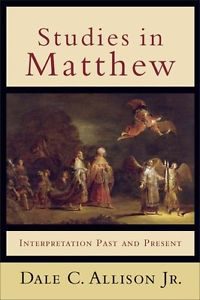
s-l300Allison, Dale C., Jr., “Reading Matthew through the Church Fathers.” In Studies in Matthew: Interpretation Past and Present. Grand Rapids: Baker, 2005.
Allison argues that attending to the Church Fathers is a good way of becoming attuned to the kind of allusions that the Gospel writers may have been making to the OT texts. Though not all the allusions the Father’s saw may be valid, they raise possibilities for our consideration. Allison gives several examples including comparing Moses, the meekest man  with the Beatitude: “Blessed are the meek for they shall inherit the earth.”

Allison, Dale C., Jr., “Seeing God (Matt. 5:8).” In Studies in Matthew: Interpretation Past and Present. Grand Rapids: Baker, 2005.

Allison surveys several historical options for what it means to see God. That part of the essay was helpful. Oddly, he concludes that the meaning most likely original to Matthew is unorthodox (that God is embodied and will be seen) even though he cites Psalms in support of another option which is orthodox. Helpful data; unhelpful conclusions.

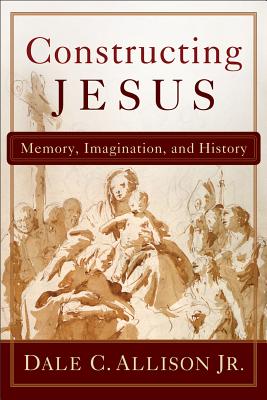
9780801048753_lAllison, Dale C., Jr. “Excursus 1: The Kingdom of God and the World to Come.” In Constructing Jesus: Memory, Imagination, and History. Grand Rapids: Baker, 2010.
This forty-page excursus is a detailed survey of Jesus’s kingdom sayings in the Synoptics. Allison first lists the 58 kingdom sayings by corpus (e.g., “From Mark,” “Common to Matthew and Luke,” etc.). He then investigates these sayings, drawing on Old Testament and related extrabiblical literature along two line: what is the “nature of the kingdom” and how does it relate to “the world to come.” He argues against the idea that βασιλεία means reign rather than realm. While not discounting reign as part of the semantic domain, Allison makes a strong case that realm is also a signfiicant part of the semantic domain. Recently, I’ve found Micahel Goheen, Jonathan Pennington, and Patrick Schreiner arguing similarly. With regard to the world to come, Allison sees a strong orientation to the world to come. In his own words, “My judgment, then, is that ἡ βασιλεία τοῦ θεοῦ is, in the Synoptics, a realm as well as a reign; it is a place and a time yet to come in which God will reign supreme,” though he follows this by saying, “I wish to reaffirm emphatically that מלכות and βασιλεία often do . . . refer to kingly authority or royal reign” (201).

My own assessment is that Allison convincingly demonstrates that realm is a significant part of the kingdom of God theme. I do think, however, that he under-emphasized the present aspect of the kingdom.

Allison, Dale C., Jr. “More Than an Aphorist: The Discourses of Jesus.” In Constructing Jesus: Memory, Imagination, and History. Grand Rapids: Baker, 2010.

In this essay Allison argues that the core of the Sermon on the Plain is a preserved discourse of Jesus (rather than a collection of Jesus sayings collected by the evangelist) that drew heavily on Leviticus 19. In the course of the essay Allison also highlights quotations from or allusions to the Sermon on the Plain in a variety of New Testament and early Christian writings. The documentation of these quotations and allusions along with the notation of parallels with Leviticus 19 is valuable. The rest of the essay was, given my disagreement with Allison’s critical presuppositions, a futile, if learned, exercise.

Filed Under: Biblical Studies, Book Recs, Matthew

Warfield on Shorter Catechism One: To Glorify God and Enjoy Him Forever

March 9, 2017 by Brian

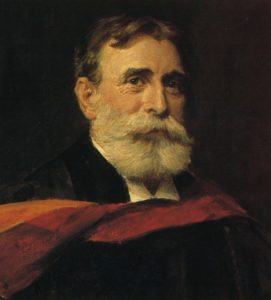
WARFIELD-Benjamin-B.-IpsenWarfield, Benjamin B. “The First Question of the Westminster ‘Shorter Catechism.'” In The Works of Benjamin B. Warfield. Volume 6. 1932; Reprinted, Grand Rapids: Baker, 2003.

The first question of the Westminster Shorter Catechism is perhaps the most famous of all catechism questions: “Q. What is the chief end of man. A. The chief end of man is to glorify God and to enjoy Him forever.” This is an excellent article tracing the origins of this question through earlier catechisms and theologies. It also contains a helpful discussion about the “enjoy” part of the answer.

For instance:

 For justice is not done that conception if we say merely that man’s chief end is to glorify God. That certainly: and certainly that first. But according to the Reformed conception man exists not merely that God may be glorified in him, but that he may delight in this glorious God. It does justice to the subjective as well as to the objective side of the case. The Reformed conception is not fully or fairly stated if it be so stated that it may seem to be satisfied with conceiving man merely as the object on which God manifests His glory—possibly even the passive object in and through which the Divine glory is secured. It conceives man also as the subject in which the gloriousness of God is perceived and delighted in. No man is truly Reformed in his thought, then, unless he conceives of man not merely as destined to be the instrument of the Divine glory, but also as destined to reflect the glory of God in his own consciousness, to exult in God: nay, unless he himself delights in God as the all-glorious One.

Read the great Reformed divines. The note of their work is exultation in God. How Calvin, for example, gloried and delighted in God! Every page rings with this note, the note of personal joy in the Almighty, known to be, not the all-wise merely, but the all-loving too. Take, for example, such a passage as the exposition of what true and undefiled religion is, which closes the second chapter of the First Book of the Institutes. [pp. 396-97]

Filed Under: Anthropology, Book Recs, Dogmatics, TheologyProper

Jane Austen, Jacobs on the Book of Common Prayer, and Robinson’s Gilead

March 8, 2017 by Brian

s-l1000Jacobs, Alan. The Book of Common Prayer: A Biography. Lives of Great Religious Books. Princeton University Press, 2015.
In keeping with this series, Jacobs traces the origins, reception, and effect of the Book of Common Prayer. As always with Jacobs, excellently written, informative, thought-provoking.

Austen, Jane. Mansfield Park.

I would rank this, alongside Sense and Sensibility as one of my favorite Austen novels. An insightful meditation on the distinction between true manners and acted manners, the role of the clergy in society, etc. There is also food for thought here about the parent-child relationship.

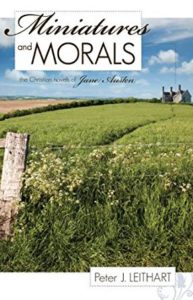
Leithart, Peter J. Miniatures and Morals: The Christian Novels of Jane Austen. Moscow, ID: Canon Press, 2004.51VstTdcQkL._SY445_QL70_

This is an enjoyable exegesis of Austen’s novels. Repeatedly Leithart showed what I thought to be helpful insights. As to the subtitle, I think Leithart demonstrated Austen to have been a committed Anglican who grew in sympathy to evangelical Christians and who adroitly addressed moral issues in her novels. The book does suffer, however, from a lack of footnotes. Leithart will quote other critics by name. The bibliography provides the works, but no page numbers are supplied.

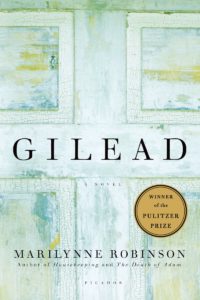
91k3cIBsWSLRobinson, Marilynne. Gilead.

Though Robinson is often praised as a Calvinist author who seeks to recover Calvin and religion for a modern audience, she often does this by pulling her punches. She doesn’t want to come across as stuffy, so the main character at times winks at ungodliness. She has a discussion of predestination between two characters, but the main character can’t bring himself to actually embrace Calvin’s view. She shies away from affirming eternal punishment. The ethos of the book is not that of the Reformation but of the Protestant Mainline.

Filed Under: Book Recs, Uncategorized

Anderson and Young on the Identity of Darius the Mede

March 1, 2017 by Brian

Anderson, Steven D. and Rodger C. Young, “The Remembrance of Daniel’s Darius the Mede in Berossus and Harpocration,” Bibliotheca Sacra 173 (July-Sept. 2016): 315-23.

These authors argue that there is extrabiblical evidence for a king Darius prior to Darius I found in Berossus and Harpocration. This Darius fits in time period and position the Darius the Mede mentioned in Daniel. The most interesting evidence comes from Berossus, who wrote: “Cyrus at first treated him [Nabonidus] kindly, and, giving a residence to him in Carmania, sent him out of Babylonia. (But) Darius the king took away some of his province for himself.” This would place Cyrus and Darius as contemporaneous rulers. The authors say in a footnote they are inclined to identify this Darius with the Cyaxares II found in Xenophon’s Cyropaedia, though this is not argued for in this article.

I have been inclined to see Darius the Mede and Cyrus the Persian as two names for the same person, but I find the argument of this article intriguing.

Filed Under: Biblical Studies, Daniel

Miroslav Volf on Human Flourishing

February 27, 2017 by Brian

Volf, Miroslav. “Human Flourishing.” In Renewing the Evangelical Mission, ed. Richard Lints. Grand Rapids, MI: Eerdmans, 2013.

In this essay Miroslav Volf provides a brief and broad historical survey of views of human flourishing accompanied with evaluation and a proposal. Volf’s survey begins with Augustine, for whom human flourishing was found in love for God and neighbor. With the Enlightenment God dropped away, but love for neighbor remained a part of the conception of human flourishing. “The central pillar of its vision of the good life was a universal beneficence transcending all boundaries of tribe or nation and extending to all human beings” (16). In late 20th century, however, human flourishing came to be understood simply in terms of “experiential satisfaction.” Volf concludes: “ours is a culture of managed pursuit of pleasure, not a culture of sustained endeavor to lead the good life” (15).

The problem, Volf explains, with making pleasure or “experiential satisfaction” at the heart of human flourishing is that humans are never satisfied. Even when they achieve what they want, there is more to want. “Our striving can therefore find proper rest only when we find joy in something infinite” (19).

Another problem with equating human flourishing and pleasure is the disconnect between creation and human flourshing that emerges. Volf observes, “Satisfaction is a form of experience, and experiences are generally deemed to be matters of individual preference. Everyone is the best judge of their own experience of satisfaction” (25). He argues that in contrast to this approach most religions and philosophies have argued that human flourishing is tied to the nature of reality. Though Volf does not provides exegetical argumentation for this being the correct position, I would argue that the exegetical foundation is present in Proverbs 8’s teaching that God built wisdom/law into the structure of creation and in Psalm 1’s teaching that wisdom is to live in accordance with this law with flourishing as the result.

In enunciating what this fit between reality and flourishing is, Volf returns to Augustine and summarizes his position in four points: “First, he believed that God is not an impersonal Reason dispersed throughout the world, but a ‘person’ who loves and can be loved in return. Second, to be human is to love; we can choose what to love but not whether to love. Third, we live well when we love both God and neighbor, aligning ourselves with the God who loves. Fourth, we will flourish and be truly happy when we discover joy in loving the infinite God and our neighbors in God” (27-28). Again, though Volf does not bring it out, there is a connection with Psalm 1. It is in meditating on (and then living out) the law of God (which can be summarized in loving God and others) that humans flourish.

Filed Under: Anthropology, Book Recs, Christian Living, Dogmatics

  • « Previous Page
  • 1
  • …
  • 38
  • 39
  • 40
  • 41
  • 42
  • …
  • 87
  • Next Page »