
Vanhoozer, Kevin J. and Owen Strachan. The Pastor as Public Theologian: Reclaiming a Lost Vision. Grand Rapids: Baker, 2015.
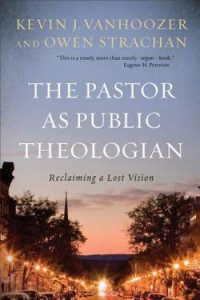 There are certain books whose effect largely depends on the time in life when you read them. For instance, I’d say that Frank Thielman’s Paul and the Law: A Contextual Approach was one of the most significant books that I read while in seminary. It was while reading that book that I understood for the first time the significance of the biblical covenants. I know that I had read about the covenants before, but their role in Scripture and my relation to them clicked for the first time while reading Thielman. That book may not have been as significant to my thinking had I already developed my thinking on the covenants and on the Mosaic Law. I have the sense that Vanhoozer and Strachan’s could have a similar effect on a seminarian or pastor—it could reshape the way they think about ministry. Others will already share their vision, making the book less significant to them.
Vanhoozer and Stachan’s basic message is that pastors need to reclaim their vision of the pastorate from secular sources and seminaries need to be reshaped so that pastors rightly see their mission to be that of theologians. The pastor theologian is not an academic. Rather, he is a public theologian in the sense that he helps God’s people live out God’s Word in all of life. There are a number of ways that a pastor achieves this goal (e.g., pastoral visitation, counseling), but the sermon ought to be the central means.
I’m in agreement with the central message of the book, but some things gave me pause. I remain unconvinced that Rowan Williams, for instance, is really the most faithful model to set before readers. I also remain skeptical that the Christological offices of prophet, priest, and king are a model for pastoral ministry.

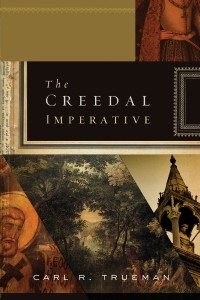 One question I face in class as a church historian is, ‘If doctrine develops, does this mean that what unites us to Christ changes over time too?’ This is an excellent question and, indeed, a rather obvious one when one is investigating the history of doctrine. Two things need to be borne in mind here.
 To trust in works, which one ought to do in fear, is equivalent to giving oneself the honor and taking it from God, to whom fear is due in connection with every work. But this is completely wrong, namely to please oneself, to enjoy oneself in one’s works, and to adore oneself as an idol.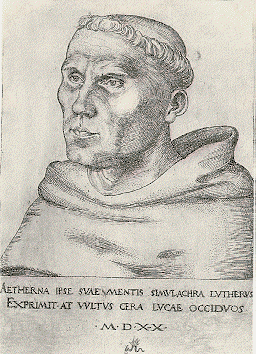
 (Crossway, 2013), 150, citing GRA, 4:490.
 Here once more we are reminded that our Lord’s method must ever be the pattern and example for all preaching. That is not true preaching which fails to apply its message and its truth; nor true exposition of the Bible that is simply content to open up a passage and then stop. The truth has to be taken into the life, and it has to be lived. Exhortation and application are essential parts of preaching. We see our Lord doing that very thing here. The remainder of the seventh chapter is nothing but a great and grand application of the message of the Sermon on the Mount to the people who first heard it, and to all of us at all times who claim to be Christian.
 , Grand Rapids: Eerdmans, 1960), 2:218.